


Small Closet Storage Solutions: Double Your Space
Last updated: 7/5/2026
A small closet isn’t a small problem. It’s the reason your chair collects clothes, your shoes live in the hallway, and getting dressed feels like an archaeological dig.
Here’s the good news: in over 35 years of designing closets, we’ve learned that most small closets waste 30–50% of their usable space. The fix usually isn’t a bigger closet — it’s a smarter one.
This guide covers the small closet storage solutions we use every day: how to reclaim vertical space, choose the right hardware, and lay out a reach-in closet so it works like one twice its size.
Quick wins for a small closet:
- Add a second hanging rod — the single fastest way to double hanging capacity
- Go floor-to-ceiling — the top 2 feet of most closets sit empty
- Swap deep shelves for drawers or pull-outs — you can’t use what you can’t reach
- Use angled shoe shelves — see every pair without stacking
- Edit first — the cheapest storage is not storing what you never wear
Start With a Ruthless Audit
Before you buy a single organizer, spend 30 minutes understanding what you’re actually storing. Every great small closet design starts here.
Measure the Real Space
Grab a tape measure and record:
- Width, depth, and height of the closet interior
- Door type and swing — bifold, sliding, and hinged doors each change what’s accessible
- Obstacles — bulkheads, outlets, vents, and baseboards all affect the design
Count What You Own
Sort your wardrobe into four buckets: long hanging (dresses, coats), short hanging (shirts, folded pants), folded items, and shoes/accessories. Most people discover they own far more short-hang items than long — which is exactly why the standard single rod wastes so much room.
Vertical Space Is Your Biggest Untapped Asset
Look up. In a typical 8-foot closet with one rod at 66 inches, everything above the rod and below the clothes is dead air.
Double Hanging Changes Everything
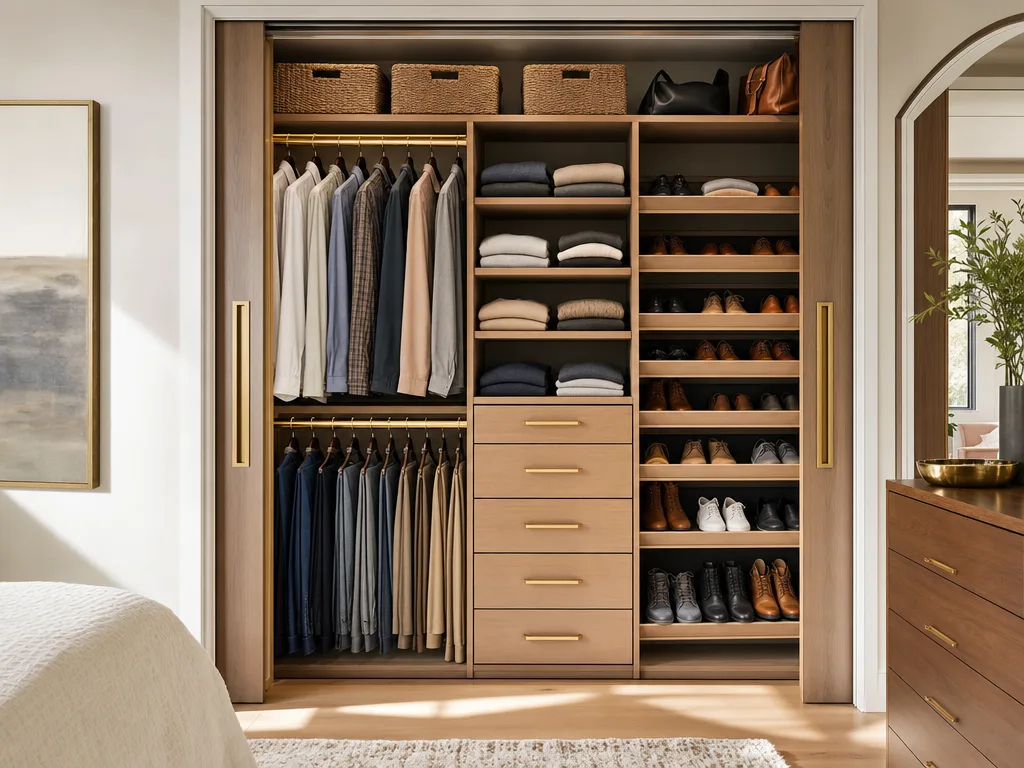
Shirts, blazers, and folded trousers only need about 40 inches of drop. Stack two rods — one high, one low — and you’ve doubled your hanging capacity in the same footprint. Reserve a narrow single-hang section for dresses and coats, and give the rest of the closet to double hang.
Claim the Top Shelf (Properly)
The shelf above the rod usually becomes a landslide of loose sweaters. Instead:
- Add a second high shelf for true floor-to-ceiling storage
- Use matching labelled bins for off-season clothing and luggage
- Keep everyday items below shoulder height, occasional items up top
Build to the Floor
Open floor under hanging clothes collects clutter. Low drawers, cubbies, or angled shoe shelves put that zone to work and give the whole closet a clean, built-in look. You can see how these zones come together in real projects in our gallery.
Choose Storage That Fits How You Reach
In a small closet, access matters as much as capacity.
Drawers Beat Deep Shelves
Anything stored more than 14 inches deep on a shelf effectively disappears. Drawers bring the back of the closet to you. In our designs, dovetail drawers with full-extension slides let you see every item at once — no more excavating for the bottom of the stack.
Pull-Outs Add Function Without Footprint
Some of our favourite space-savers for compact closets:
- Pull-out pant racks — a dozen pairs in the width of one hanger
- Valet rods that extend to stage tomorrow’s outfit, then tuck away
- Pull-out hampers that hide laundry behind a clean drawer front
- Belt, tie, and scarf racks mounted on slides in narrow gaps
Browse the full range of closet accessories to see what fits your routine.
Solve Shoes Once and For All
Shoes eat small closets alive. Angled, adjustable shoe shelves display every pair face-out and fit more in the same vertical run than flat shelves or floor piles. For deep off-season storage, clear bins up top keep boots dust-free and visible.
Layout Tricks That Make Small Feel Big
Zone the Closet Like a Boutique
Give every category a home: double hang here, folded knits there, shoes below, accessories in drawers. When each item has one obvious place, the closet stays organized without effort — the system does the work.
Light It So You Can Actually See
A dark closet feels smaller and works worse. Integrated LED strips under shelves and along hanging sections make every corner usable — we covered the details in our complete closet lighting guide.
Keep Finishes Light and Consistent
Light-toned finishes and mirrored or high-gloss door fronts bounce light around and visually expand a tight space. Matching hangers sound trivial, but they buy back real inches of rod space and instantly calm the visual noise.
Steal Space From the Door
The door is bonus square footage most people ignore. On a hinged door, a slim over-the-door organizer holds shoes, scarves, or accessories without blocking the swing. Better still, if a sliding or bifold door is stealing access to half your closet, consider replacing it — a properly hung hinged or pocket door can open up the entire interior at once, which changes what layouts are possible.
Custom vs. Off-the-Shelf: What’s Worth It in a Small Space?
Wire kits and modular towers are fine starting points. But small closets are precisely where custom earns its keep, because every wasted inch is a bigger percentage of the whole.
A custom reach-in design is measured to your exact walls, your exact wardrobe, and your ceiling height — not the average of everyone’s. Floor-to-ceiling construction, drawers sized to your folded stacks, and hanging sections planned around your actual clothes routinely recover 40% or more usable capacity compared to a single rod and shelf. Explore our bedroom and closet solutions to see what a fully fitted reach-in can hold.
Frequently Asked Questions
How do I maximize storage in a small closet?
Add a second hanging rod for short items, extend storage to the ceiling, replace deep shelves with drawers or pull-outs, and use angled shelving for shoes. Together these changes can roughly double the usable capacity of a typical reach-in closet.
How much hanging space do shirts and pants need?
Shirts, blouses, and blazers need about 38–40 inches of vertical drop; pants folded over a hanger need roughly the same. That’s why double hanging works — two 40-inch sections fit comfortably in a standard 8-foot closet.
Are custom closets worth it for a small reach-in?
Often more so than for large closets. Because a custom system is built to your exact dimensions and wardrobe, it eliminates the wasted gaps that off-the-shelf kits leave behind — and a well-fitted closet is a lasting upgrade to the home itself.
What should I do with off-season clothing in a small closet?
Rotate it out. Store off-season items in labelled bins on your highest shelf, under the bed, or in another closet, and swap twice a year. A small closet holding only the current season feels twice as large.
Ready to Rethink Your Small Closet?
You don’t need more square footage — you need a design that uses every inch you already have. For over 35 years, we’ve been designing, manufacturing, and installing custom closets that turn cramped reach-ins into hardworking, beautiful storage. Book a free consultation and let’s see how much space is hiding in your closet.
Related Articles

How to Maximize Space in a Small Walk-in Closet
Practical small walk-in closet tips from custom closet designers: double hanging, corner planning, and layout choices that can more than double your storage.
Read more →
How to Measure a Reach-In Closet: DIY Guide + Checklist
Learn how to measure a reach-in closet accurately in six simple steps. Our pros share the tools, techniques, and mistakes to avoid before you order anything.
Read more →
Home Office Built-Ins That Actually Work: A Design Guide
Design home office built-ins that work as hard as you do — smart storage, ergonomic layouts, hidden cable management, and a video-call-ready backdrop.
Read more →